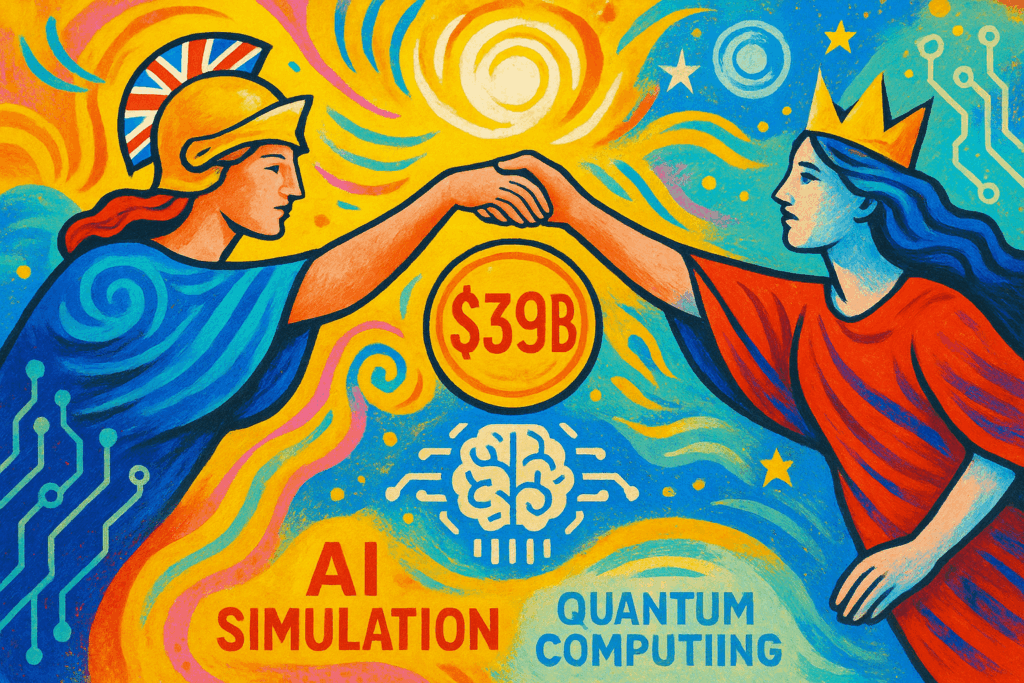
The convergence of machine learning and quantum simulation is moving from theoretical promise to practical prototypes. AI-driven models are now paired with quantum processors to represent complex quantum states more efficiently, opening new pathways for materials science, drug discovery, and high-fidelity financial modeling. This article outlines the recent technical advances, why they matter, and what to watch next.
Recent Breakthroughs in Quantum AI Simulation
Researchers and companies have refined hybrid workflows that use classical neural networks to compress and guide quantum simulations. Techniques such as neural-network quantum states, variational quantum algorithms guided by reinforcement learning, and data-driven error mitigation are producing higher-fidelity results on noisy intermediate-scale quantum hardware. Instead of relying solely on larger quantum circuits, teams train classical models to approximate many-body wavefunctions, then use a modest quantum processor to validate and refine those approximations. This reduces required qubit counts and circuit depth while improving convergence for problems like electronic structure and lattice models.
Major labs and firms from academia and industry including university groups at MIT and Oxford, and companies such as IBM, Google, Xanadu, and Rigetti, are publishing experimental demonstrations and open-source toolchains that link ML frameworks with quantum SDKs. The net effect is a practical route to tackle simulations that were previously inaccessible to classical methods alone.
Implications and Future Outlook
For materials and drug discovery, hybrid AI-quantum simulation can predict binding energies and emergent properties with finer resolution, accelerating candidate selection. In finance, improved risk models and optimization routines could emerge from fast quantum-aided sampling. Near term challenges remain: qubit error rates, integration overhead, and the need for standardized benchmarks. Progress is likely to come in incremental but meaningful steps where classical models shoulder much of the work and quantum devices provide targeted quantum advantage.
Over the next 2 to 5 years expect growing tool interoperability, clearer application case studies, and more industry partnerships that move validated use cases from labs to pilot deployments.
QuantumAIInsiders.com will continue tracking these hybrid advances, highlighting where AI and quantum simulation together shift what is computationally possible.