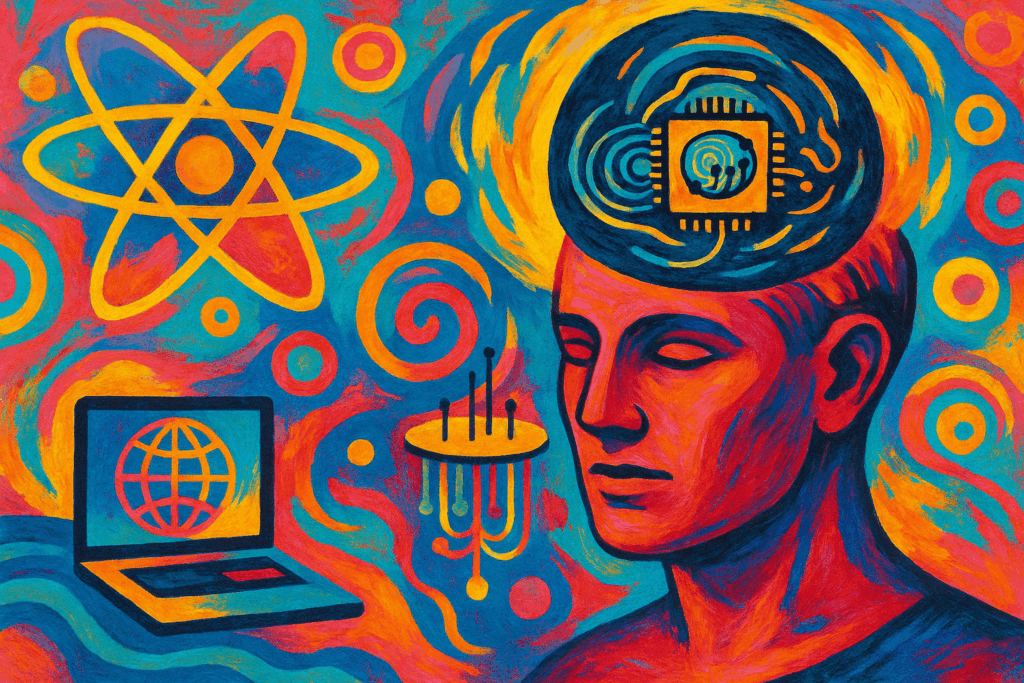

Quantum Breakthrough Unveiled
Researchers have announced a validated demonstration of a fault-tolerant logical qubit built with quantum error correction. The experiment shows a logical qubit maintaining coherence and correctable operations longer than its physical components, marking a practical step toward scalable quantum machines.
What This Means for Technology
Physical qubits are prone to noise and errors. Error correction uses multiple physical qubits to encode a single logical qubit that can detect and correct faults during computation. Today’s demonstration proves that error-corrected operations can outperform their raw components in stability and reliability. This reduces one of the largest barriers to running extended quantum algorithms.
For AI and machine learning, longer-lived logical qubits mean more complex quantum subroutines can be executed reliably within hybrid quantum-classical workflows. Applications that may benefit include quantum-assisted optimization for training models, faster sampling methods, and specialized kernels for near-term quantum-enhanced inference. Reliable logical qubits also support more realistic benchmarking for algorithms that target practical advantage rather than isolated metrics.
The Road Ahead: Quantum’s Next Steps
Important engineering work remains. Researchers must lower overheads, improve gate fidelities, and scale the number of logical qubits while streamlining control electronics and software stacks. Standards for benchmarking error-corrected systems will help the field compare progress across platforms.
In the near term, expect incremental improvements and demonstrations linking logical qubits to concrete algorithmic tasks. Over the next several years, these advances could move quantum computing from laboratory milestones to industry pilots that augment AI workflows and solve specialized problems classical systems struggle with.
Stay tuned to Quantum AI Insiders for updates on deployments, benchmarks, and what this means for investors, developers, and researchers working at the intersection of quantum computing and AI.