AI Agents Ignite Scientific Discovery
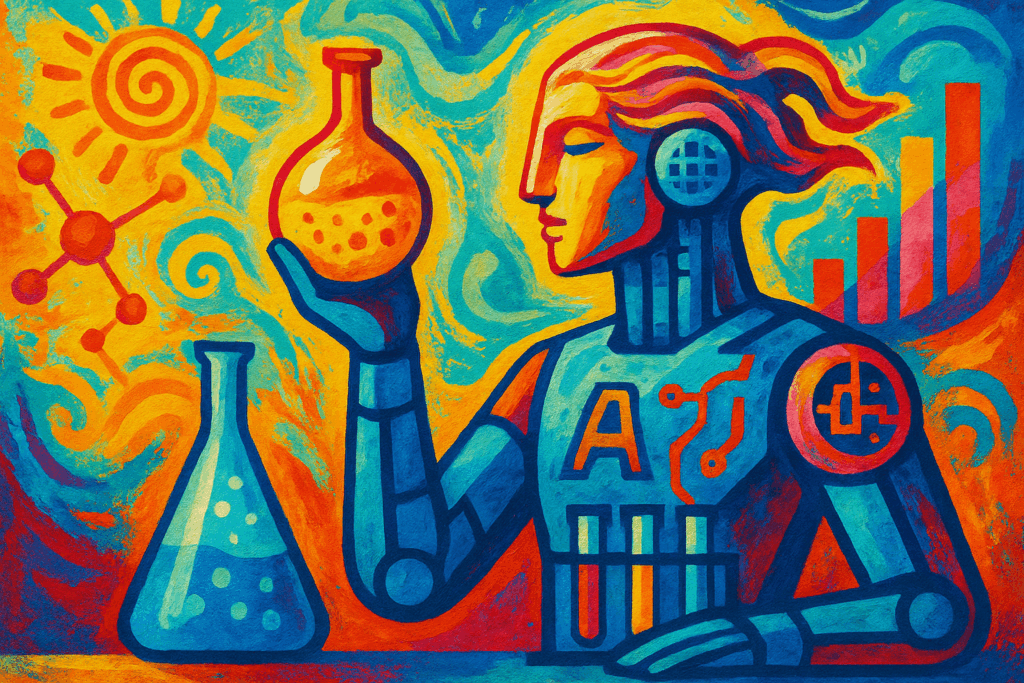
AI agents are reshaping research workflows by automating simulation, analysis, and experimental planning. Catalyst discovery offers a clear example: models propose candidate materials, run fast simulations, and recommend experiments, compressing months of human effort into days or hours. Teams at Nvidia, Meta and Google are investing in tools and infrastructure to push this shift into mainstream R&D.
From Weeks to Minutes: The AI Advantage
Machine Learning Interatomic Potentials (MLIPs) replace costly quantum calculations with learned approximations that run orders of magnitude faster. Agents such as “El Agente” coordinate MLIPs, routing work to the best model and scheduling follow-up lab tests. Tasks automated or accelerated include structure generation, energy evaluation, active learning loops, and experiment selection, turning multiweek pipelines into iterative cycles that complete in minutes to hours.
Data’s Critical Role in AI-Driven Science
High-quality, standardized datasets are the backbone of reliable AI models. Initiatives like Open Catalyst provide curated training sets for surface interactions and adsorption energies, enabling transferable MLIPs. Yet data consistency, metadata standards, and proprietary restrictions remain barriers. Better sharing protocols and benchmark suites help models generalize across chemistries and experimental conditions.
Scaling Breakthroughs to Industry
AI reduces uncertainty in scale-up by predicting how a catalyst will behave beyond pristine lab conditions. Closed-loop automation couples predictive models with robotic experimentation for rapid validation. Researchers such as Varinia Bernales and Ted Sargent highlight that validation remains essential: models guide which candidates to test, while automated labs and digital twins speed translation from discovery to production-ready processes.
The Horizon of AI-Powered R&D
AI agents are shifting R&D toward continuous, model-driven exploration and near-real-time validation. Autonomous labs and integrated datasets will accelerate adoption across chemistry and materials. Looking ahead, quantum computing may further extend simulation fidelity and tackle many-body problems beyond classical reach, compounding the speed and scope of AI-guided discovery.