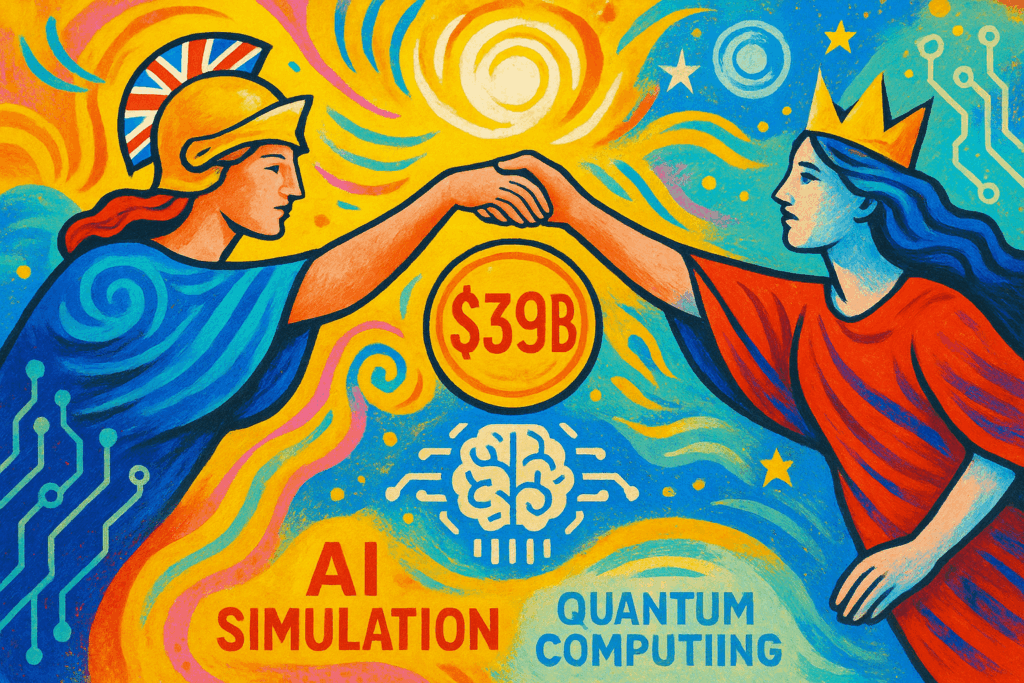

AI-assisted quantum simulation is moving from theory to tangible research tools. By combining machine learning with quantum algorithms, researchers can model larger systems, cut compute costs and surface candidate materials and molecules faster than before. This article explains what AI contributes, outlines concrete examples, and maps short-term obstacles and opportunities for practitioners and investors.
The Convergence: AI’s Role in Quantum Simulation
Quantum simulation uses quantum hardware or classical emulators to predict the behavior of quantum systems. AI contributes by building compact surrogate models, proposing efficient variational circuits, tuning parameters, and reducing noise through learned correction schemes. In practice, that means fewer quantum runs and more reliable outputs for complex many-body problems.
Driving Breakthroughs: Applications and Discoveries
Accelerating Materials Science and Chemistry
Examples are already emerging. Neural-network quantum states are being used to approximate many-body wavefunctions that were once intractable. Hybrid workflows that pair variational quantum eigensolvers with machine learning reduce the number of quantum evaluations needed to estimate molecular energies. Platforms such as PennyLane and TensorFlow Quantum enable researchers to prototype these hybrid approaches. Companies including Zapata Computing and QC Ware are offering tools and partnerships that apply these methods to catalyst design and battery materials research.
In drug discovery, ML models trained on high-fidelity quantum simulations can prioritize small molecule candidates before costly wet lab tests. That pipeline shortens lead selection and helps focus experimental budgets.
The Path Forward: Challenges and Opportunities
Key challenges include noisy hardware, limited qubit counts, scarce labeled training data, and reproducibility across platforms. Interpretability of learned quantum models is still immature, and standards for benchmarking hybrid methods are evolving.
Opportunities lie in scalable surrogate models that let classical clusters emulate larger quantum systems, improved error mitigation via learned corrections, and tailored workflows for materials and pharma that combine fast ML filters with targeted quantum runs. For investors and researchers, the immediate payoff is in hybrid approaches that deliver better results today while preparing for larger quantum hardware tomorrow.
Takeaway: AI-assisted quantum simulation is practical now for targeted use cases and will broaden as hardware and datasets improve, offering faster routes to novel materials, catalysts and molecular leads.