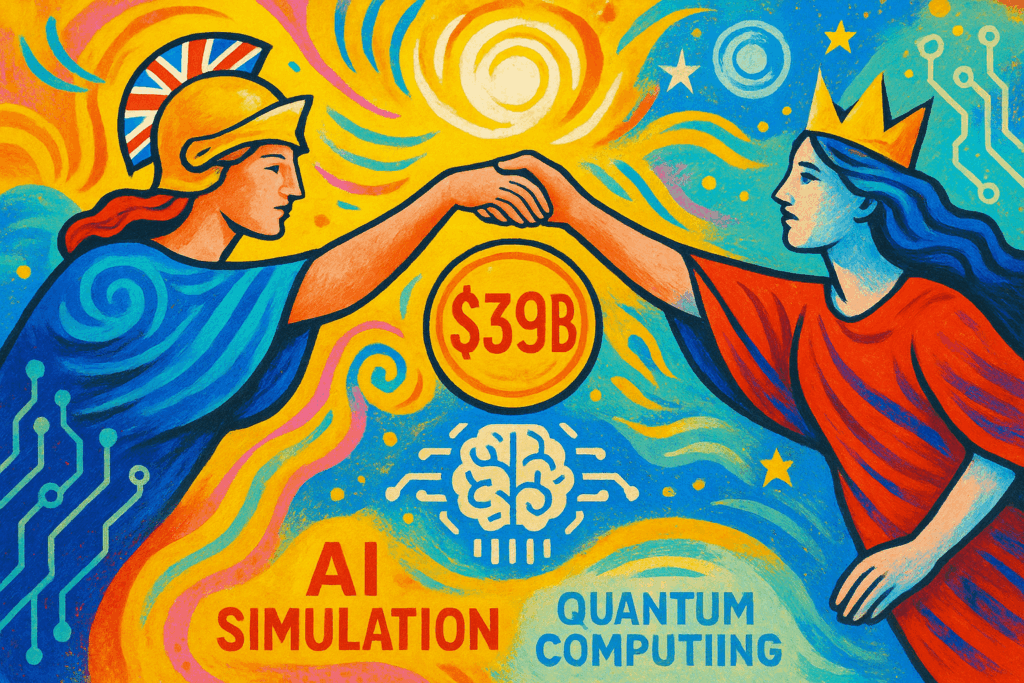

AI Supercharges Quantum Simulations: A New Era
AI-powered quantum simulation is moving from laboratory curiosity to applied research tool. By combining machine learning with emerging quantum hardware and algorithms, researchers are shrinking runtimes, reducing resource needs, and making previously intractable problems solvable within practical budgets.
Bridging Complexity: What AI Adds
Machine learning models can approximate quantum states, predict optimal parameters, and correct hardware noise. These models act as intelligent surrogates that reduce the number of expensive quantum operations. In practice, that means faster convergence for variational algorithms and more accurate estimates for many-body systems without exponential compute costs.
Real-World Impact: From Materials to Medicine
Industry-relevant wins are already emerging. In material science, hybrid AI-quantum workflows accelerate the search for stable compounds and tailored electronic properties. In drug design, models that combine quantum calculation with ML-driven screening narrow candidate pools far earlier, saving time and experimental spend. Complex system modeling, from battery chemistry to catalysts, benefits from the capacity to explore larger configuration spaces with less compute.
The Road Ahead: Potential and Progress
Near term, expect wider adoption of hybrid pipelines that pair classical ML with noisy intermediate-scale quantum processors for targeted simulation tasks. This will create tangible productivity gains in R and D, and open niche markets for specialized software and services.
Challenges remain: hardware noise, model interpretability, and the need for curated quantum datasets. Addressing these will require cross-disciplinary teams and iterative benchmarks that measure real-world value, not just theoretical speed-ups.
Bottom line: AI is making quantum simulation more usable and more useful today. For researchers and investors, the immediate opportunity lies in hybrid solutions that deliver measurable reductions in time to discovery while paving the way for broader quantum advantage tomorrow.