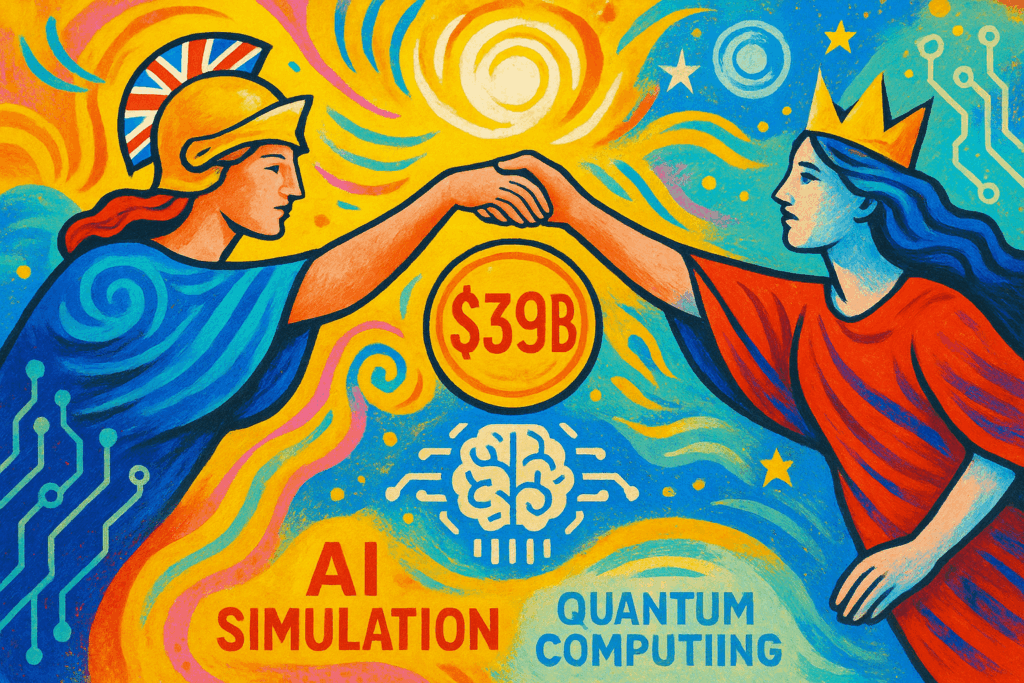

AI Simulation Meets Quantum: A New Era
Researchers have reported a new hybrid approach that combines quantum subroutines with classical AI simulation frameworks to tackle high-dimensional problems with reduced classical compute. The method pairs variational quantum circuits with generative neural models to produce more faithful simulations of molecular and physical systems while using a modest number of qubits.
Breakthrough: New Quantum-Assisted AI Model Emerges
The hybrid model routes the most computationally intensive kernel evaluations to a quantum co-processor and lets a neural simulator learn residuals. Early results show lower sample complexity for target distributions and improved fidelity on benchmark Hamiltonians compared with purely classical pipelines. Developers use error-mitigation strategies and noise-aware training to make the approach practical on near-term devices.
Why This Advancement Matters
For problems where classical simulation scales poorly, offloading specific subroutines to quantum hardware can reduce wall-clock time and resource consumption. This can shorten exploration cycles for researchers and accelerate workflows that rely on many repeated simulations, such as candidate screening and probabilistic forecasting.
Potential Applications and Industry Shift
- Pharmaceutical research: faster exploration of molecular conformations and reaction pathways.
- Materials science: improved simulation of electronic structure for battery and catalyst design.
- Finance and logistics: more efficient Monte Carlo sampling for risk and route optimization.
- Cloud providers: tighter integration of quantum co-processors into AI pipelines will create new service offerings.
The Road Ahead for Quantum AI
Obstacles remain, including hardware scale, noise, and standardized benchmarks for hybrid models. Near-term priorities are larger reproducible tests, robust error mitigation, and developer tools that simplify hybrid workflow composition. In the next 12 to 24 months, expect more open-source benchmarks and pilot collaborations between labs and cloud vendors that will show where quantum-assisted simulation delivers practical returns.
For professionals tracking this space, watch for reproducible benchmark results and integrations that let existing AI teams call quantum subroutines with minimal platform changes.