
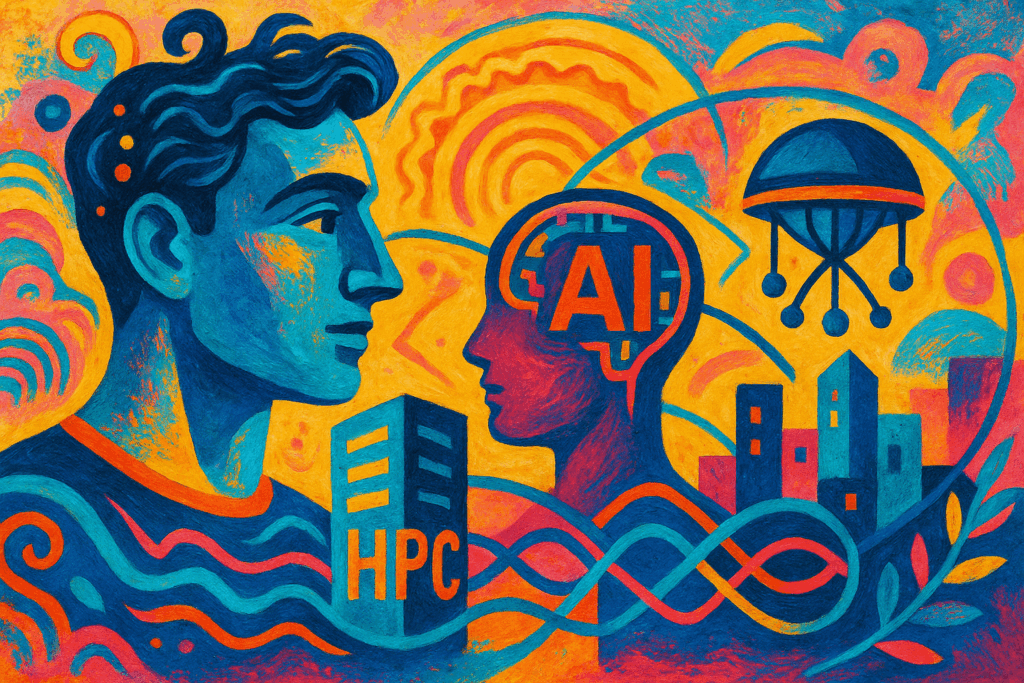
The Jülich Supercomputing Centre (JSC) is building a single operational fabric that brings high-performance computing, artificial intelligence and quantum resources into coordinated workflows. By treating HPC, AI and quantum as parts of one computational ecosystem, JSC aims to move research from isolated prototypes to production-scale science.
A Unified Vision for Advanced Computing
JSC pursues an architecture that integrates hardware, software and data pipelines. Shared storage, workflow orchestration and common user services let teams combine large-scale simulation, machine learning and quantum experiments without rebuilding infrastructure for each project. Co-design between domain scientists, systems engineers and vendors prioritizes real-world workloads rather than academic benchmarks.
JUPITER: Exascale Power for AI Breakthroughs
JUPITER is Europe’s exascale-class supercomputer at JSC. It supplies the raw compute and memory bandwidth needed to train large AI models and to run data-intensive simulations at previously unattainable resolution. The JUPITER AI Factory, JAIF, acts as an operational layer for model development, data curation and reproducible testing, enabling iterative AI research at exascale scale and accelerating transfer from prototype to production.
JUNIQ: Hybrid Quantum Computing in Practice
JUNIQ provides access to multiple quantum hardware platforms, emulators and error-mitigation toolchains. It is explicitly designed for hybrid workflows that pair quantum processors with classical supercomputers. Use cases include quantum-assisted optimization, variational algorithms for materials discovery and quantum-accelerated subroutines inside larger simulation loops. Orchestration services handle job placement, data movement and result aggregation between quantum backends and classical compute.
Charting New Horizons in Scientific Discovery
The integrated JSC model shortens time-to-insight for problems in climate, materials, and health. Exascale AI enables richer surrogates and inverse design. Quantum resources offer new methods for tackling combinatorial and many-body problems. Together, these capabilities aim to move computational science from single-discipline proofs toward multidisciplinary, production-grade pipelines that deliver measurable advances.