Nvidia’s Quantum Strategy: Powering AI-Accelerated Computing
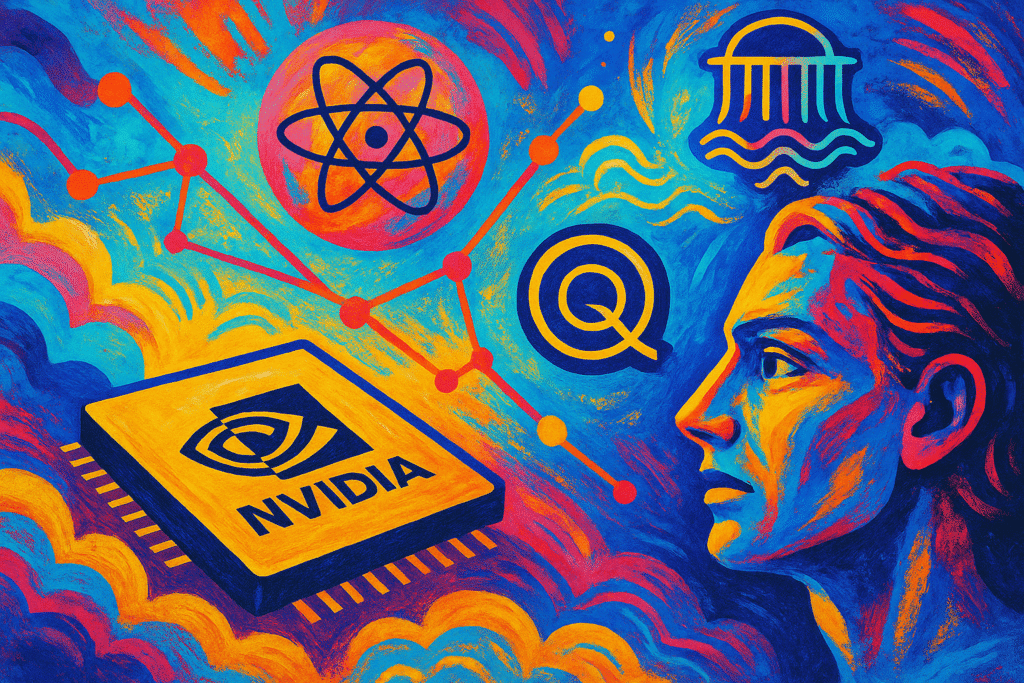
Nvidia positions itself as a platform enabler in quantum computing rather than a pure hardware vendor. The company focuses on stitching quantum processors into GPU supercomputers so quantum processors act as accelerators within broader AI and HPC workflows.
Quantum as an Accelerator: Nvidia’s Platform Vision
Rather than treating quantum processors as standalone boxes, Nvidia treats them like specialized accelerators that plug into a high-performance stack. NVQLink is central to that vision. It provides the low-latency, high-bandwidth interconnect that lets photonic QPUs and other quantum devices exchange data with GPU clusters in near real time. That integration model keeps quantum resources tightly coupled with classical compute for hybrid workloads.
Integrating AI, Simulations, and Quantum Hardware
Three pillars define Nvidia’s approach: accelerating quantum simulations with CUDA-Q, enabling quantum-classical co-processing through NVQLink, and wrapping quantum workflows in software layers that exploit AI. CUDA-Q extends the CUDA ecosystem so researchers can emulate circuits, benchmark Ising model instances and prototype algorithms on GPUs before moving to real hardware. Partners from photonic QPU developers like PsiQuantum, Quandela and Xanadu to system integrators called Orca-level teams benefit from this unified stack.
Advancing Quantum with AI for Error Correction and Applications
AI methods are already shortening engineering cycles for quantum devices. Machine learning helps build neural decoders for quantum error correction, optimizes pulse control for photonic QPUs, and accelerates state reconstruction for noisy systems. Nvidia-provided Ising model tooling and simulation scaling let teams explore algorithmic space faster, while AI reduces the time to identify error-mitigation strategies at scale.
The Inflection Point: Quantum AI’s Future
We are at an inflection point where improved error correction, tighter interconnects and AI-driven software stack growth make hybrid quantum-classical workflows practical for more problems. Nvidia’s platform-first strategy aims to make quantum resources a routine part of AI and HPC pipelines, expanding where quantum advantage will first appear in simulation and optimization.