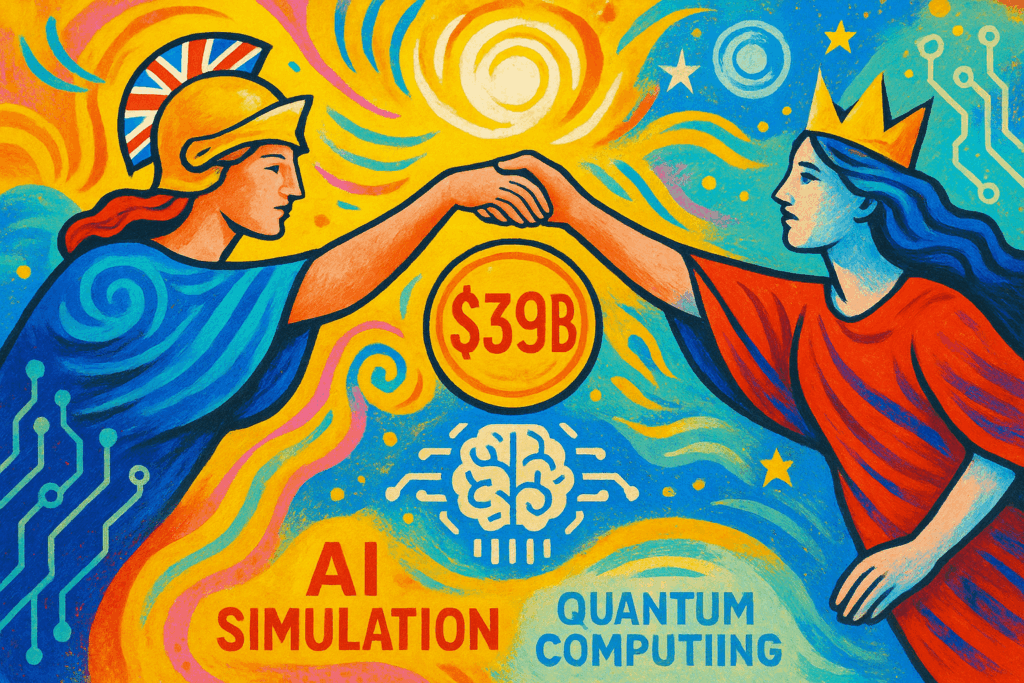

Understanding Quantum AI’s Transformative Power
Beyond Classical Limits: What is Quantum AI?
Quantum AI combines quantum computing hardware with machine learning algorithms to explore solution spaces that classical systems cannot search efficiently. Qubits exploit superposition and entanglement to represent many states at once, offering a different class of parallelism. That does not mean instant intelligence. It means new algorithmic pathways for optimization, simulation and probabilistic modeling that can outperform classical approaches on specific problems.
Real-World Applications
- Drug discovery: faster molecular simulation and candidate screening
- Supply-chain optimization: massive combinatorial routing and scheduling
- Climate modeling: higher-resolution uncertainty propagation
- Financial risk simulation: richer scenario analysis and portfolio optimization
The Strategic Imperative: Prioritizing Human Agency
The Market Landscape
Public and private funding for quantum technologies has surged. Governments and large corporations have committed tens of billions of dollars to quantum R&D, and private investment in quantum startups reached several billion in recent years. Market forecasts commonly predict multi-billion dollar value for quantum computing and allied software by the late 2020s as quantum advantage emerges in niche domains.
Why Human Agency Matters
Cornelia Walther, a Wharton visiting scholar, frames human agency as the strategic complement to Quantum AI. Machines may find novel solutions, but organizations capture value when people set priorities, interpret results and integrate outputs into decisions that account for ethics, context and long-term risk. Human agency is neither optional nor decorative; it is how leaders convert computational power into business outcomes while managing societal implications.
Preparing for the Quantum Shift
Actionable Readiness
Focus on three cross-functional areas: governance that defines acceptable use and risk thresholds, interpretability so teams can validate quantum-augmented insights, and decision design that embeds human judgment into model outputs. Build multidisciplinary teams that pair quantum practitioners with domain experts and decision architects.
Key Indicators to Watch
- Demonstrable quantum advantage: real-world tasks where time-to-solution or quality beats classical baselines
- Vendor roadmaps and access models: timelines for fault-tolerant qubits and hybrid cloud services
- Emerging governance: standards, audit frameworks and regulatory signals
The Bottom Line
Quantum AI will reshape competitive dynamics where high-dimensional search and simulation matter. The immediate strategic opportunity for leaders is not only to invest in technology but to invest in human systems that translate quantum outputs into trustworthy decisions. Organizations that build governance, interpretability and decision design now will capture disproportionate value when quantum advantage arrives.