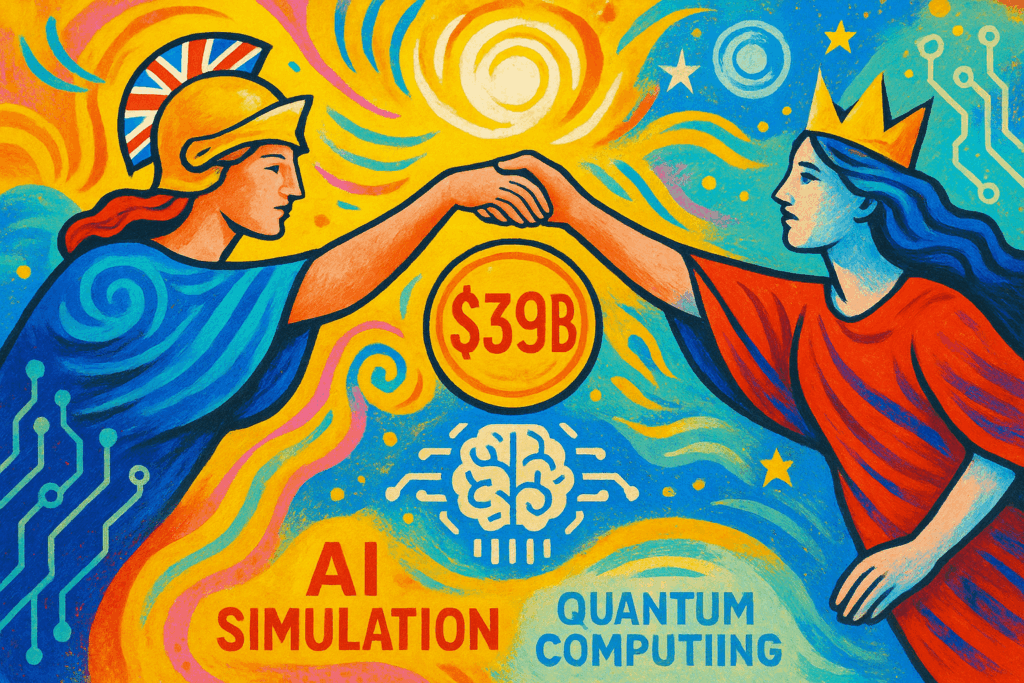

AI Simulation Meets Quantum: A New Era Unfolds
AI-driven quantum simulation brings two powerful trends together: machine learning models that learn structure from data and quantum processors that natively represent complex quantum states. The result is a practical path to simulate molecules, materials, and many-body systems with precision not achievable by classical computation alone. For investors, researchers, and technology leaders this convergence signals a shift from theoretical promise to applied capability.
Understanding the Breakthrough
Recent advances combine classical neural networks with variational quantum algorithms to lower circuit depth and the number of qubits needed for accurate results. In practice a neural model compresses the effective Hamiltonian or parameterizes trial wavefunctions while a quantum processor evaluates the hard parts of the calculation. Machine learning also improves error mitigation and optimizes circuit layout, reducing hardware overhead.
At a high level the workflow looks like this: train a model to propose candidate states, execute compact quantum circuits that validate energy or property estimates, and use a classical optimizer to refine parameters. This hybrid loop lets current noisy quantum hardware contribute meaningfully to simulations that would otherwise be out of reach for classical methods alone.
Real-World Impact and Future Trajectories
Immediate use cases include quantum chemistry for drug leads, discovery of novel battery and catalyst materials, and higher-fidelity financial risk models. Companies in pharmaceuticals and materials science are already running pilot projects that mix AI and small-scale quantum runs to prioritize experiments and reduce lab cycles.
What comes next is broader scaling via error-corrected qubits, improved quantum-classical toolchains, and domain-specific AI models that make simulations faster and cheaper. Challenges remain: hardware error rates, software interoperability, and a talent gap. Still, the roadmap is clear. Hybrid AI-quantum simulation will be a competitive advantage for organizations that adopt early and invest in cross-disciplinary teams.
For ongoing coverage of tools, startups, and research in this space visit QuantumAIInsiders.com.