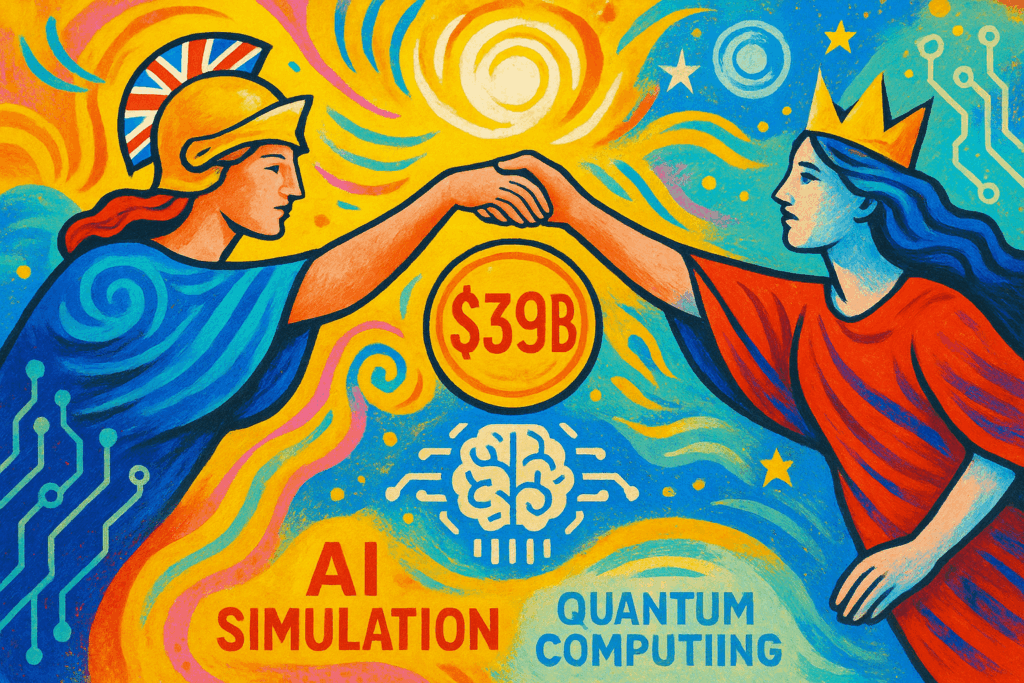

The New Frontier: Quantum-Powered AI Simulation
Quantum computing is reshaping AI simulation by offering fundamentally different ways to represent and explore complex systems. Rather than only aiming for raw clock-speed improvements, quantum methods change how models search vast solution spaces and generate probabilistic samples. For practitioners and leaders, that means simulations that can probe problems classical systems struggle with, from molecular interactions to combinatorial optimization.
Why Quantum for AI? Unlocking New Capabilities
Quantum machines exploit superposition and entanglement to process many candidate states at once. That property can translate into advantages for machine learning tasks that rely on large-scale linear algebra, high-dimensional sampling, or rugged optimization landscapes. Quantum algorithms such as quantum amplitude estimation and variational routines offer alternative paths to faster sampling and sharper solution search. In the near term, hybrid quantum-classical workflows pair quantum subroutines with conventional neural nets and optimizers, yielding practical gains without waiting for fault-tolerant hardware.
Impact and the Path Ahead
Expect tangible impact in areas where simulation fidelity matters: drug discovery and protein folding, materials design, supply chain optimization, and complex financial modeling. Near-term shifts will come from quantum accelerators that improve sampling and optimization, quantum-inspired algorithms that run on classical hardware, and cloud-accessible quantum services integrated into existing ML stacks. Hardware noise and scale limits remain constraints, but steady progress in qubit quality, error mitigation, and algorithm design is shortening timelines.
For researchers, investors, and enterprise teams, the takeaway is pragmatic optimism. Quantum-powered AI simulation will not replace classical methods overnight, but it will expand the frontier of solvable problems and open strategic advantages for early adopters who combine domain expertise with hybrid quantum workflows.