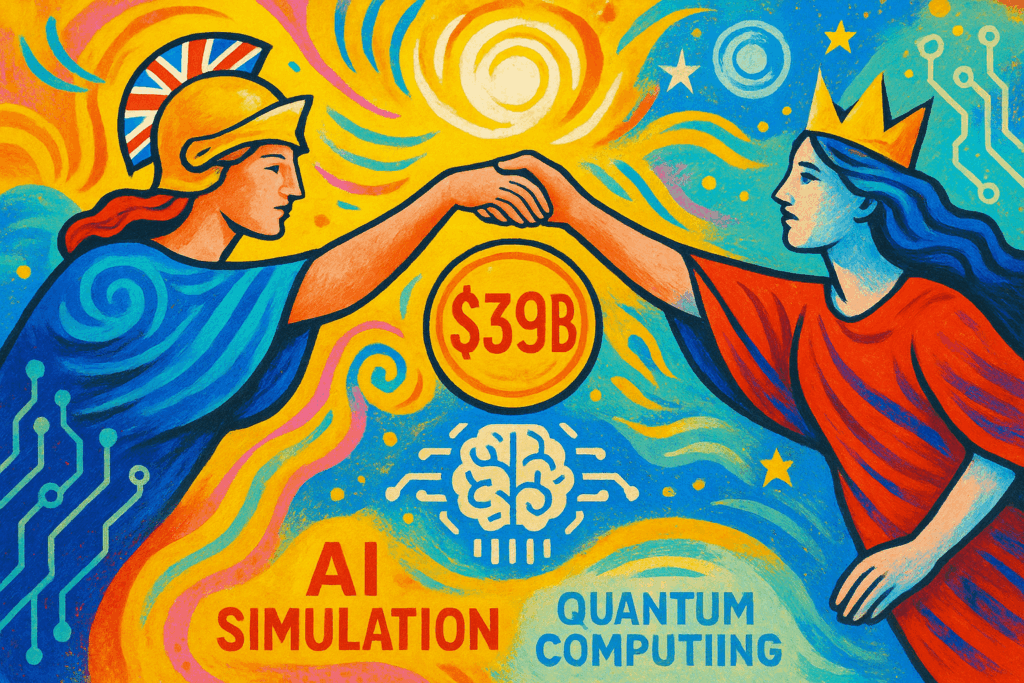

The convergence of quantum computing and artificial intelligence is moving from research labs to practical deployments. For organizations that run large-scale simulations, combining quantum processors with classical AI stacks promises lower computational cost, faster iteration, and new modeling approaches that were previously impractical.
Quantum Computing Powers Next-Gen AI Simulations
Quantum processors excel at certain numerical tasks that are central to simulation workflows. Problems that depend on high-dimensional linear algebra, complex optimization, or probabilistic sampling can see meaningful speed-ups when a quantum co-processor is applied selectively. That makes quantum-assisted AI particularly relevant for physics-based simulations, generative modeling, and systems that require rapid scenario testing.
Driving AI Efficiency with Quantum Advantage
Tackling Complex AI Challenges
Key mechanisms by which quantum capability improves AI simulation workflows include:
- Faster linear algebra primitives for dense matrix operations used in training and inference.
- Quantum-enabled optimization and sampling that reduce iterations for hard-to-converge models.
- Hybrid quantum-classical pipelines where variational circuits offload specific subroutines while classical networks handle remaining work.
- Quantum kernels and amplitude encodings that compress high-dimensional representations, reducing classical memory and compute demands.
These approaches do not replace classical AI. They act as accelerators that let teams explore larger model spaces, shorten training cycles, and produce higher-fidelity simulation results with fewer classical resources.
Industry Collaborations Fueling Innovation
From Hardware to Algorithms: Building the Future
Telefónica Tech and partners such as Qilimanjaro, Multiverse, and Qcentroid illustrate the multi-party model required to field usable quantum-AI services. Telecom and systems integrators supply connectivity and edge deployment expertise. Hardware vendors bring quantum processors and control systems. Algorithm and software teams integrate quantum routines into existing AI toolchains so enterprises can adopt hybrid workflows without rebuilding pipelines from scratch.
The Future of AI Simulation and Beyond
Near term, expect targeted wins in simulation-heavy sectors including materials modeling, logistics optimization, and virtual testing. Edge AI and rapid prototyping benefit when quantum modules cut iteration time for complex scenarios. For decision-makers and investors, the strategic value lies in early adoption of hybrid architectures that scale classical investments with quantum accelerators as the hardware matures.
QuantumAI Insiders will track deployments and practical benchmarks as they appear, helping technical leaders separate promising approaches from speculation.