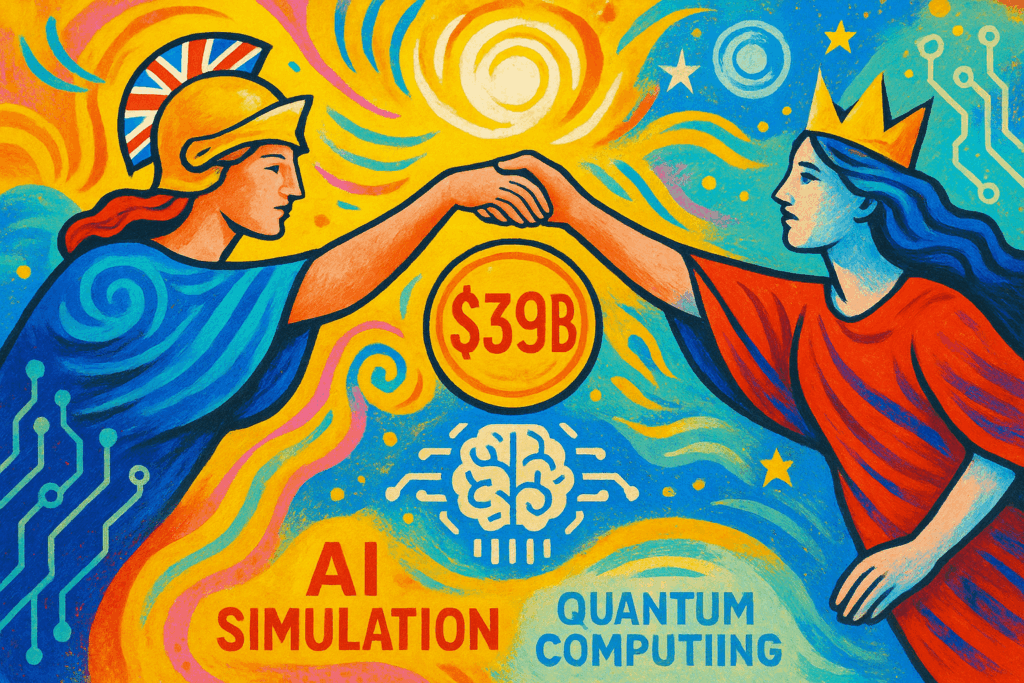
As compute architectures converge, a new class of hybrid systems is emerging that couples exascale high performance computing, AI model factories, and quantum processors. These integrated platforms promise to expand the scale and scope of scientific simulation, optimization, and discovery beyond what any single paradigm can deliver.
Integrating Power: Exascale AI Factories Meet Quantum
Hybrid HPC-AI-quantum computing refers to workflows that combine traditional simulation engines, AI training and inference pipelines, and quantum subroutines. Exascale AI factories are large-scale, production-grade stacks for automated model training, validation, deployment, and continuous data ingestion at exaflop-class throughput. In practice, they provide the capacity to run massive ensembles of physics-informed models, surrogate networks, and reinforcement learners that can be paired with quantum processors for select workloads.
Quantum’s Contribution to Advanced Simulations
Quantum computing does not replace classical simulation. Instead it offers new algorithmic primitives for problems such as strongly correlated quantum systems, combinatorial optimization, and sampling. When integrated with AI and classical simulators, quantum routines can reduce sample complexity, refine Hamiltonian models, or propose high-quality candidate solutions for further classical refinement. Combined workflows enable tighter uncertainty quantification and faster iteration on models for materials, chemistry, and complex systems.
GCS and ISC 2026: Pioneering Hybrid Frontiers
Germany’s Supercomputing Centres play a leading role in prototyping these hybrid stacks, assembling the hardware, middleware, and orchestration needed to co-schedule CPUs, GPUs, and quantum backends. ISC 2026 will showcase practical demonstrations: end-to-end pipelines, porting patterns, and benchmarks that reveal where hybrid approaches deliver measurable advantage for real research problems.
Implications for Quantum AI and Beyond
For the quantum AI community, integrated exascale-AI-quantum systems mean access to production-scale data, robust model factories, and the ability to insert quantum primitives where they yield the greatest marginal gain. Near term impacts include improved surrogate models, accelerated discovery cycles, and new hybrid algorithm patterns. Long term, standardized software stacks and shared benchmarks will determine which scientific domains benefit first and how industrial adoption follows.