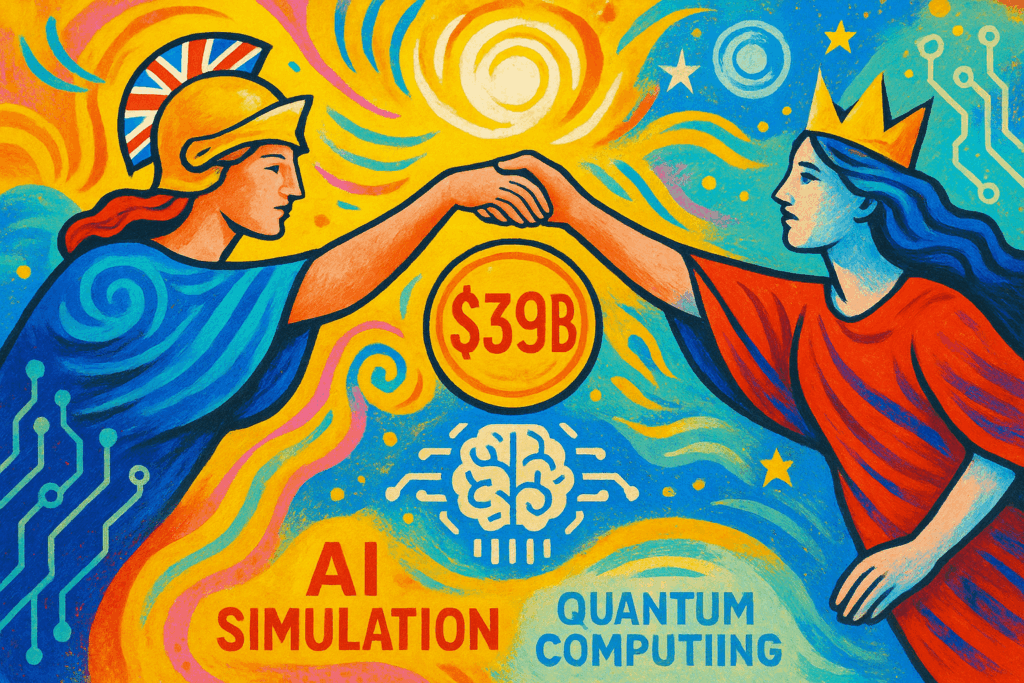

2025 marked a shift from landmark demonstrations to systems that matter for AI-driven simulation. Improvements in qubit fidelity, meaningful steps toward fault tolerance, and tighter integration of quantum and classical hardware moved quantum platforms toward practical simulation tasks used in materials science, chemistry, and ML model components.
Qubit Fidelity and Error Correction Advance
IBM, Google Quantum AI, IonQ, and Quantinuum reported steady gains in single- and two-qubit gate fidelities and early logical qubit experiments. IBM expanded surface-code experiments that reduced effective error rates, while IonQ and Quantinuum leveraged trapped-ion coherence to push algorithm runtimes longer. Google published benchmarking that clarified noise sources, allowing more targeted error mitigation. Collectively, these steps make small-scale fault-tolerant workloads for simulation more credible.
Hybrid Architectures and Scalability Efforts
NVIDIA and cloud providers accelerated hybrid stacks that pair GPUs with quantum coprocessors for pre- and post-processing of quantum tasks. NVIDIA’s work on high-speed interconnect ideas and IBM’s collaborations with AMD and major cloud providers focused on lowering latency between classical simulators and quantum processors. Microsoft continued to extend its Azure Quantum toolchain to simplify hybrid workflows, giving developers practical paths to test quantum-accelerated components inside larger AI pipelines.
Real-World Applications and the Quantum Internet
Google reported reproducible instances of verifiable quantum advantage for narrowly defined sampling and optimization problems, highlighting where quantum subroutines can offer speed or fidelity benefits in simulation workflows. At the same time, industry efforts toward quantum networking and secure links by IBM and partners aim to let distributed quantum resources be shared for collaborative simulation, opening possibilities for federated quantum-assisted model training and multi-site materials studies.
A Transformative Year for Quantum
2025 did not deliver universal, fault-tolerant quantum machines, but it brought coherent technical progress across fidelity, stacking, and integration. For practitioners focused on AI simulation, the year clarified where near-term payoffs may appear: hybrid pipelines, targeted quantum subroutines, and networked resources. The path to widely deployed quantum simulation is clearer and closer than it was at the start of the year.